
Symbol Of Truth For Mankind

The cube

It was, indeed, the will of the One who “possesses the highest attribute” that the content of the Qur’an should be congruent with the innate disposition of the messenger who thus became a living embodiment of its guidance and its laws. He moved among men on earth as a living, revealed book comprising morals, sayings and deeds from which even the illiterate and those unable to speak his language could derive benefit, for “the Messenger of God (SWT) is a good example for everyone who hopes for God (SWT) and the last day, and who greatly remembers God (SWT).”

God (SWT) – may He be exalted – has bestowed upon mankind “many facets to every kind of lesson” with respect to the innate disposition of the Prophet (PBUH), and these correspond fully to the many-faceted lessons stated in His divine Revelation as a whole. As He says: “Thus indeed We have given in this Qur’an many facets to every kind of lesson designed for the benefit of mankind. However, man is, above else, always given to contention.” He did this so that form and content, word and meaning should fully coincide. The Prophet (PBUH) therefore becomes a living mirror reflecting the essence of divine mercy which is also the ultimate purpose of the message sent down in the Qur’an: “And thus, O Prophet, We have sent you as a mercy for all the worlds.”

Taken together, the Qur’an as word of God (SWT) and Muhammad as messenger of God (SWT) to mankind exist in parallel with another dual entity, namely the order prevailing in the cosmos and the capacity for the perception and generation of order which exists in the collective human intellect. This is a phenomenon of the profoundest significance, especially if we take into account the conformity between the two types of order – the cosmic and the intellectual – which represents the essence of knowledge in its objective sense. Indeed, without this compatibility no objective knowledge of any kind would be possible for man to attain. However much our knowledge, our ways of thinking and our understanding of the universe change and develop, this essential conformity between the order of the cosmos and the order of the intellect remains unaltered fact. While objective knowledge of physical reality arises on account of this congruence, the knowledge of what is absolute and certain emanates from that other proven congruence, that between the Qur’an and Muhammad (PBUH). Both types of knowledge, the objective and the absolute, are but two aspects of one single knowledge whose source is the All-knowing Creator, Originator of both the universe and the intellect, who bestowed the Qur’an and dispatched His messenger.

One of the Prophetic Hadith which occupies an absolutely pivotal position in Islam is the one concerning the Divine Names (Attributes): “God (SWT) has ninety-nine names, one hundred minus one, for He is singular and loves singularity; whoever enumerates them enters Paradise.”
The cube

When analysing the words of this Hadith in their context we are confronted with a number of pressing questions which require to be answered, especially if we accept the premise that the Prophet (PBUH) did not “speak out of fancy” in all he said, not excepting even a word or a letter. As space is limited we will restrict ourselves to the following issues:

  1. Why the mention of ninety-nine?
  2. What is meant with the expression “one hundred minus one”?
  3. Does the reality of ninety-nine differ from that of one hundred minus one?
  4. What is the meaning of “God (SWT) is singular and loves singularity” in this context?
  5. What is the meaning of “enumeration” here and why does the Hadith link enumeration with entry into Paradise?

One Hundred Minus One in the Qur’an

Before attempting to answer this question, we must turn to the Qur’an in order to examine verses 21 to 25 of Sura Ṣād (38). This is the sole Qur’anic passage which narrates an event that concerns the relationship between ninety-nine and one, and thereby also sheds light on the relationship between these numbers and the concept of cosmic justice. The text is as follows:

(21) And yet has the story of the litigants come within thy ken – the story of the two who surmounted the wall of the sanctuary in which David prayed?
(22) As they came upon David and he shrank back in fear of them, they said: “Fear not! We are but two litigants. One of us has wronged the other; so judge thou between us with justice, and deviate not from what is right, and show both of us the way to rectitude.”
(23) “Behold, this is my brother: he has ninety-nine ewes, whereas I have only one ewe; and yet he said: ‘Make her over to me,’ and forcibly prevailed against me in this [our] dispute.”
(24) Said [David]: “He has certainly wronged thee by demanding that thy ewe be added to his ewes.” Thus do many kinsmen wrong one another – all save those who believe in God (SWT) and do righteous deeds; but how few are they!
(25) And suddenly David understood that We had tried him: and so he asked his Sustainer to forgive his sin, and fell down in prostration and turned unto Him in repentance.

Despite the fact that this Qur’anic story on the relationship between the ninety-nine and one appears in a context which is rather less abstract than that of the aforementioned Hadith of the Prophet (PBUH), the true intent of its meaning still remains mysterious. David clearly states that it is a matter of injustice to request that to the ninety-nine be added a further one, to make up the figure one hundred.

What, however, is the basis of his judgment with which David settles the dispute between the two litigants? While the text does not enlighten us on his reasoning, we cannot ignore the fact that it is a matter of grave consequence, especially if we take account of the Qur’anic verse that follows directly upon this story: “O David! We have made thee a vice-regent (khalīfa) on earth; judge then between men and do not follow vain desire lest it lead thee astray from the path of God (SWT).”

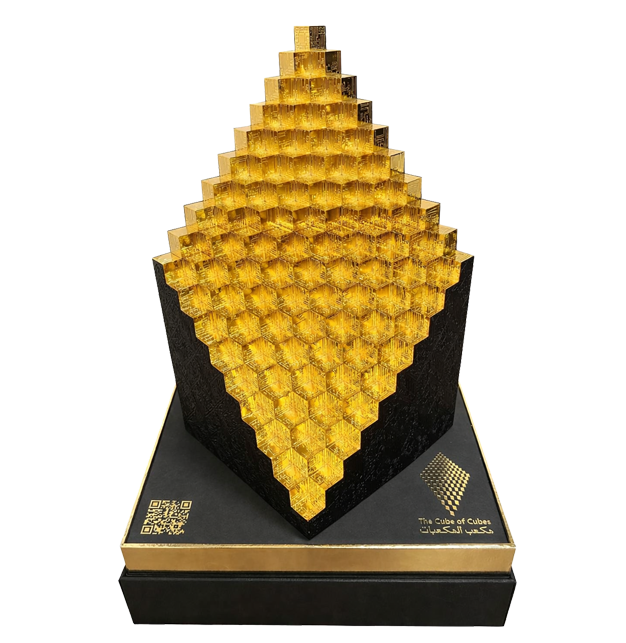
Taken as a whole, the story explains to us what is really meant by the fact that God (SWT) appoints man as His vice-regent on earth. It shows that there is an indissoluble link between the realisation of this regency on the one hand, and just rule among mankind in keeping with the Truth and in conformity with the dictates of cosmic justice on the other. The latter are manifest, however, in the abiding, God-given laws and significations contained in the cube, i.e. the Ka‘ba, to which the story makes covert reference as we shall presently explain.

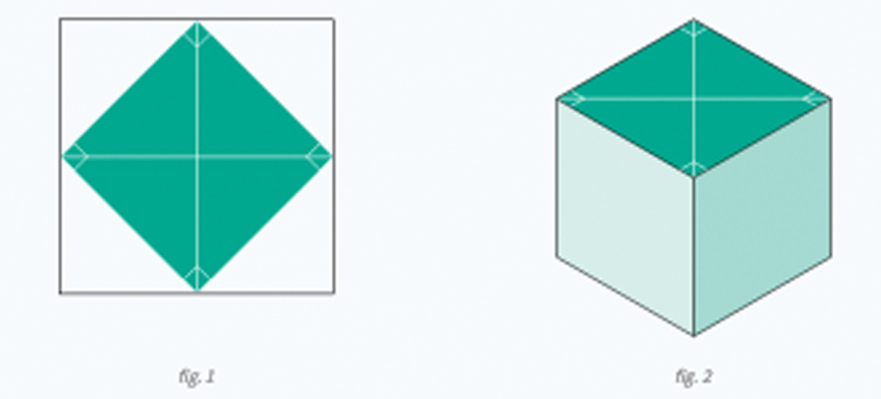
If we examine, as a first step, the properties of the square as a geometrical figure we notice that it is representative of equality in two dimensions, length and breadth, since the four lines and four angles it consists of are, respectively, all exactly equal in size (see fig. 1). This equality remains flawless and unchanged no matter how large the surface area encompassed by the square. Since the cube can be considered a manifestation in the third dimension of all the properties of the square, it exhibits the same type of equality, but in three, instead of two dimensions, and this no matter how large its actual size might be (see fig. 2). The laws upon which it is based are inherently stable, whether it is large or small.

The cube

This enduring stability is a characteristic which distinguishes the cube from all other regular solids. Moreover, the six sides of the cube are equivalent to the six cardinal directions — forwards, backwards, left, right, up and down. On account of these singular characteristics Aristotle considered the cube as representative of the ideal or Perfect Man (al-insān al-kāmil). As he stated in his discourse on happiness, “Man is in reality good and a perfect cube.” These words are indicative of the enduring and pervasive solidity of this structure which does not display any irregularity or alteration no matter what angle it is observed from. As such the cube itself is a sign of the solidity of the Perfect Man who remains unchanged in all circumstances since his being is a constant affirmation of the names and attributes of God (SWT).

Before Him, all conditions, all opposites and pairs are fused into one, since the Outer and the Inner, the Manifest and the Hidden are but two sides of one single reality. His names are indicative of this fact, for He is — may He be exalted — both the One Who Grants Life (al-Muḥyī) and the One Who Brings Death (al-Mumīt), the One Who Takes Away (al-Qābiḍ) and the One Who Gives Abundantly (al-Bāsiṭ), the One who Raises to Honour (al-Muʿizz) and the One Who Humiliates (al-Mudḥill), the First before Whom there is nothing (al-Awwal) and the Last after Whom there is nothing (al-Ākhir), and so on.