
A vision of harmony and meaning.
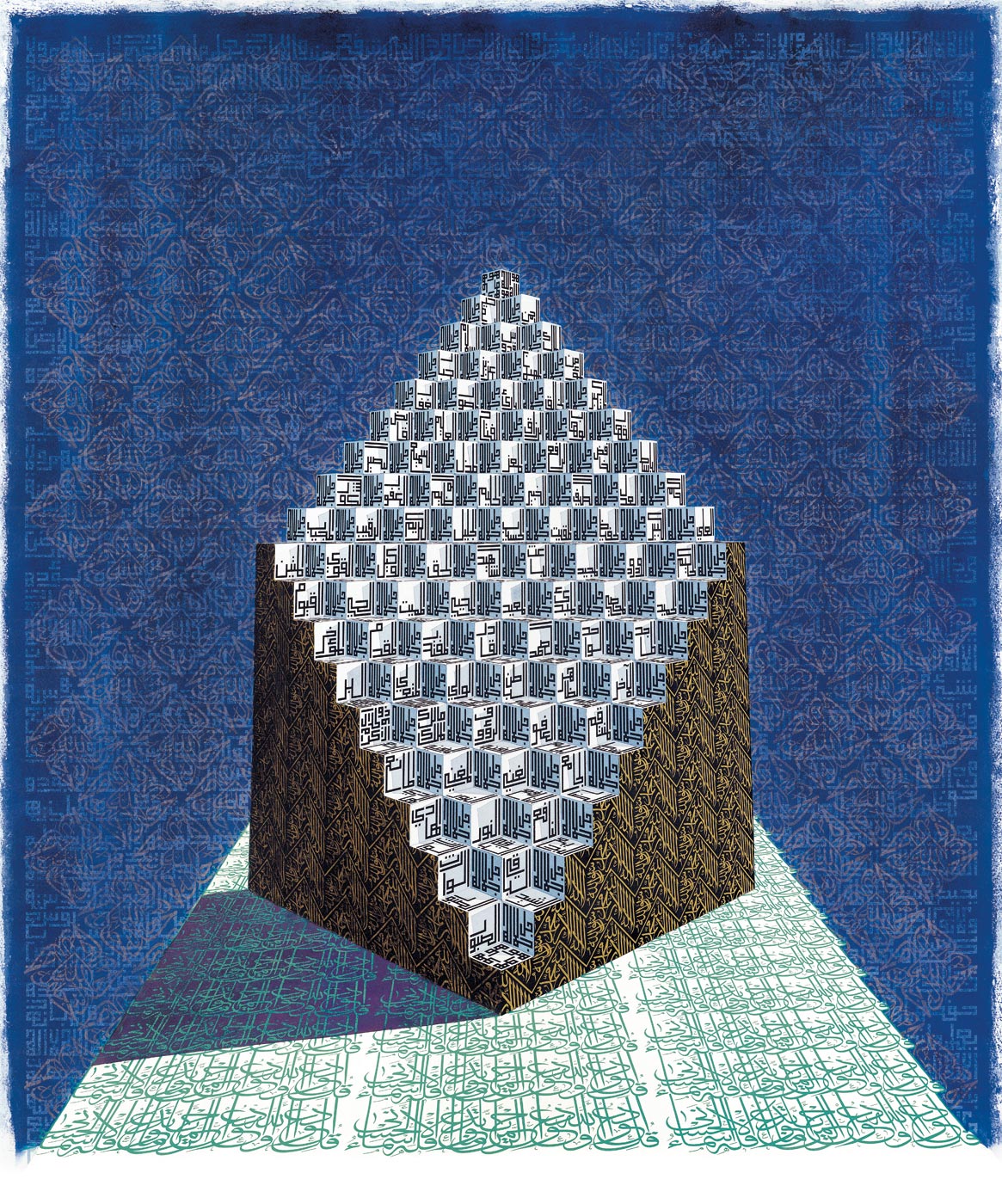
The original inspiration for The Cube of Cubes was born from “The Most Sublime Purpose in Explaining the Attributes of Divine Perfection”, the treatise by Abu Hamid al-Ghazzali (450-505 AH/1058-1111 AD). This led to creating ‘The Attributes Of Divine Perfection’ composition (shown above) by the prominent Arab artist and scholar, Dr. Ahmed Moustafa.
It should be stated from the outset that Dr. Moustafa’s representation of ‘The Attributes Of Divine Perfection’ is not a merely subjective or imaginative illustration but an objective representation of the inherent relationship between the One and the Many, and, more specifically, an embodiment of the well-known prophetic hadith: “God (SWT) has ninety-nine names, one hundred minus one. Whoever enumerates them enters Paradise.”
Dr. Moustafa’s depiction of ‘The Attributes of Divine Perfection’ is not in any sense a personal conception, invention, speculation or conjecture but is a disclosure, unlocking or unveiling of sacred knowledge, an objective rationale uniting the meaning of the hadith with a form which explains, expresses and illuminates it. Its impact lies in the fact that its form is perfectly wedded to its meaning.
The visual depiction of ‘The Attributes of Divine Perfection’ makes the relationship between Unity and Multiplicity immediately accessible and palatable to us through its concrete and tangible form, even though there are many layers of meaning which will only reveal themselves to us through prolonged study, contemplation, devotional practice and action. To this end the accompanying book will assist believers to enumerate their portion of the divine attributes in the conduct of their own lives, while remembering that the perfection of all the Names belongs to God alone, for the servant assumes the attributes and names as his traits and becomes adorned by them only to a specific limit. Even then, it always needs to be borne in mind that, given the limitations of man, it is his conscious intentions that will be judged, for “nought shall be accounted unto man but what he is striving for” (Quran 53:39).
Dr. Moustafa’s composition illuminates the paradox of the simultaneous Absence and Presence of God, “utterly remote in His limitless glory” (Quran 59:23), yet “closer to you than your jugular vein” (Quran 50:16).